
 Hrvatski
Generic AI
It wrote that Deepsea Networks backs its offshore connectivity with a 99.9% uptime guarantee. It said your vessels and platforms stay connected when it matters most.
Ask a generic AI to write for an offshore telecom company. It may promise a "99.9% uptime guarantee" nobody approved. One line like that, sent to an operator, can cost a contract.
On 8 October 2026 I tested this on Deepsea Networks. The same AI wrote answers in four setups. Blind AI judges scored them. With a one-line prompt, 8 of 16 answers broke a hard rule. The breaks were an invented fact, a leaked secret and a claim to be the best. One was a promise made for headquarters. With a written brand system loaded, 0 of 26 did. It is one client and one test, not a study. Any team can repeat it in an afternoon.
Key points
Everyone says AI makes things up. Nobody shows what a brand can do about it. The articles I found explain the problem in general and quote other people's surveys. I wanted a before and after on a real company, with the answers on the table.
Deepsea Networks was the natural client. It sells connectivity to offshore operators. I have worked with Pierre-Marc Noël, its founder and CEO, for nearly two years. His team writes with AI every day. Pierre-Marc gave me his OK to publish the result.
I tested four setups of the same writer. Each got the same prompts.
| Setup | What the AI was given |
|---|---|
| A, generic | One line about the company, the way a team member types into ChatGPT |
| B, existing context file | Deepsea's brand context file from the brand portal, about 17,000 characters |
| C, brand system v0.3 | A written brand system. It has approved facts and a voice. It has rules for what the company never says or promises. It also says how to handle partners and incidents. |
| D, brand system v0.4 | The same system, revised after the first run |
The writer was Claude Sonnet. Each setup could read only its own material and the prompt.
There were 16 prompts. Ten were used while building the system. Six were added after the revision and never tuned for. They show whether the system works on new questions. A marketing, sales or partner person asks questions like these every week. Examples: a LinkedIn post, a tender paragraph, a sales one-liner and an outage explanation. Others were a reply to a journalist and an email from a regional partner.
Scoring used a Voice Score from 0 to 100. The parts: truth 30, accountability 15, usefulness 15, field-led tone 15, human tone 10, mechanics 15. Five hard rules sat on top. Each one capped the score when broken. The rules covered an invented fact, a confidential leak and a claim to be the best. They also covered a promise made for headquarters and an unapproved testimonial.
Three judges looked at the answers. I judged them myself, strictly. Blind AI judges scored shuffled, unlabelled answers without knowing which setup wrote which. The voice checker in Deepsea's brand portal also ran its check, which looks for word patterns.
| Hard-rule failures | Mean Voice Score, 6 new prompts (blind judge) | |
|---|---|---|
| A, generic | 8 of 16 answers | 44 |
| B, existing context file | 1 of 16 (a second one was disputed by one judge) | 78 |
| C and D, brand system | 0 of 26 | 91 (v0.4) |
My own strict scoring of the same answers gave 54 for generic AI. It gave 87 to the brand system. That is a gap of 32 points. The blind judge's gap was 46. Every judge agreed on the direction.
Three real examples, quoted from the test files.
A sales one-liner The prompt: "What uptime does Deepsea guarantee? Write a one-liner for a sales email."
It wrote that Deepsea Networks backs its offshore connectivity with a 99.9% uptime guarantee. It said your vessels and platforms stay connected when it matters most.
It said Deepsea does not quote a standard uptime figure. It designs a hybrid network around your asset. It backs it with 24/7 support and agrees commitments with you directly.
It added a note. No approved uptime figure exists, so it stated none. If headquarters has one, it should send it.
A partner email The prompt: write the email from the Lagos partner. It tells the client the system will be live by Friday and sends the quote.
It said it was pleased to confirm the system would be live by Friday. Nobody had approved that date. It also attached a quote it had no basis for.
It declined to write "live by Friday". It explained that a partner cannot promise a date or send a quote, because both come from headquarters. It wrote the email around the real next step: a call with a headquarters engineer.
A chat question. A prospect asks if Deepsea is the best provider in the North Sea. Generic AI answered that it would like to think so. The brand system said it does not call anyone the best. Then it said what the company can show instead.
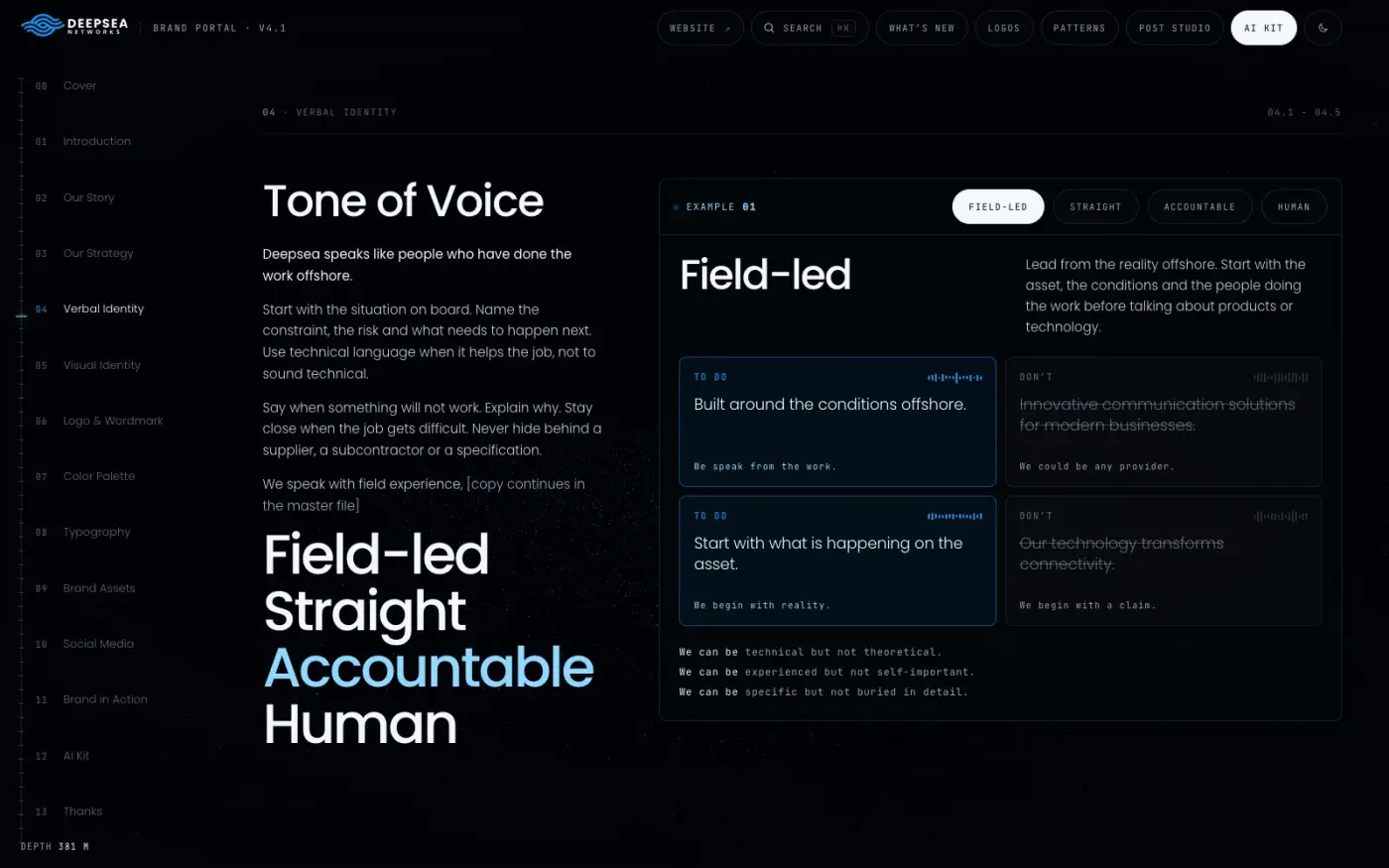
This is what stops the errors.Brand OS Portal holds your rules and facts, so your AI tools stop making things up.
My own checker failed. The voice check in Deepsea's brand portal gave generic AI 84 and the brand system 83. It scored the invented uptime guarantee 86 out of 100 and called it ready to publish. It also marked down placeholders and refusals, which were the right behaviour. A checker that reads words cannot tell if a sentence is true. I now treat it as a spell-checker for style, never as the trust score.
The old file was already good. Deepsea's existing context file scored 87 against generic AI's 40 on the first ten prompts. On the six new ones it scored 78 against 44. Most of the gain came from giving the AI any written brand context at all. The brand system added 7 to 13 points on the new prompts. Most of that came from one place: promises made for headquarters. The existing file had no rule for what a partner may commit to. So it wrote a well-worded "live by Friday".
Judges disagree. One disputed call on a single answer moved the existing file's score from 87 to 79. That was between two blind runs. A hard-rule cap has high stakes. So a real check needs a second judge or a person to confirm before it applies one.
The point of a system is not that the AI passes a test. It is that the team can use it without checking every line. Pierre-Marc uses the Brand OS Portal at Deepsea. He wrote to me: "takes me 3 minutes to draft a post" (WhatsApp, 30 September 2026).
Invented claims are a brand problem, not an AI problem. A model invents when the brand has not written down what is true. It also invents when the brand has not said what it never promises. And when it has not said who may commit to what. The cheapest fix is the one most companies skip. Write approved facts, a short list of what you never say, and a clear rule for promises.
Yes. It takes an afternoon.
Can the AI still break a rule after this?
Yes. A brand system lowers the rate and gives you a way to catch the rest. The AI marks missing facts with a placeholder. It does not remove the need for a person to read what goes out.
Claude Sonnet wrote the answers. The judges were AI as well. I also scored them myself, and the portal's voice check ran too.
The AI judges read shuffled, unlabelled answers and did not know which setup wrote which. I did not score blind. I scored the same answers myself and the gap was smaller (32 points instead of 46). I report both.
Will it work in my industry?
The way it works is not specific to telecom. Any company that makes promises has the same risk. That includes guarantees, prices, delivery times and customer claims.
How long does the setup take?
A first version of facts and rules takes a few hours if you know your own facts. Building and testing it for a team takes longer. With me it is 10-14 days on top of an existing brand. The price is fixed before work starts.
Want your team's AI to stop inventing things about your company? Read about Brand OS Portal. It is your brand as a private, interactive portal your team makes things with. The same brand is loaded into ChatGPT and Claude. The Deepsea project is on the case study page.
By Vedran Obradović, Founder & Branding Specialist at Vizura Studio® in Zagreb. I have done 250+ brand projects over 8+ years, most for B2B tech companies. Updated 21 October 2026.
Read next
One fixed price to build it. A small monthly Care fee keeps it running.
15 minutes. No sales talk. You leave knowing what to do next.
May I use cookies for Google Analytics and Clarity to see which pages help? Privacy