





AI-ready brand guidelines: what they are and what goes in them

Your team asks ChatGPT for a LinkedIn post. It comes back with a promise nobody approved. Your brand guidelines could have stopped it. But they are a PDF the tool has never opened.

Tech teams I built brands for

MTGDeepsea NetworksBreachKORDINPolarisMiraiTalentixUnderdogTrackarooStratosyncArrowpointVerticommImpactPilotEdgeClear

Free AI-Ready Check

AI-ready brand guidelines fix that. They are brand guidelines written so ChatGPT and Claude can follow them. They hold the facts the AI may use and the promises it must never make. They show your voice in examples. They add a check before anything goes out. A PDF made for designers is not enough, because the tools your team writes with never open it.

Key points

  • A normal brand book tells designers what the logo and colours are. It says nothing a writing tool can use.
  • AI-ready guidelines add six parts: facts, never-promise rules, voice in examples, prompt kits, a check, and one live place for all of it.
  • You need both. The PDF stays for people who design and print. The AI kit is for the tools that write.
  • In one test I ran, AI without the guidelines invented promises like a 99.9% uptime guarantee. With them loaded, it did not. Details are below.

Why do normal brand guidelines fail with AI?

Because they were written for a different reader. A designer opens the PDF and finds the hex code and the clear-space rule. ChatGPT, Claude and Copilot do not open anything. They answer from what they learned in training. They also use what is pasted into the chat. With search on, they use what they find online about you.

When the model knows little about your company, it fills the gap with a confident guess. That is where "99.9% uptime guarantee" comes from. It sounds like something a network company would say, so the model says it.

Here is the real case. I tested the same AI on Deepsea Networks, an offshore telecom company, with and without its brand system. With only a one-line prompt, the answers broke hard rules. One was an invented fact, one a leaked secret, and one a promise made for headquarters. One answer was a "99.9% uptime guarantee" nobody had approved. One line like that, sent to an operator, can cost a contract. The full test is in the proof section.

How are AI-ready guidelines different from a brand book?

Brand book (PDF)AI-ready guidelines
ReaderDesigners, printers, agenciesThe people on your team and the AI tools they write with
AnswersWhat does the logo look like?What can I say about the product? What must I never promise? How does the brand sound?
FormatOne long PDFShort plain-text files an AI can read, plus a place your team opens
FactsRarely includedA list of every claim, its source and its status
Rules"Be friendly and professional"Sentences a person or a tool can check a draft against
UpdatesEvery few years, if everWhenever a product, price or customer changes
Check before shippingNoneA short list every draft must pass

I build both. They do different jobs, and one cannot replace the other.

What goes in AI-ready brand guidelines?

Six parts. Each one is something you can paste, check or open. None of them lives only in a slide.

Step 1: A facts register

A list of every claim the company makes, with a status: approved, needs a check, or never use. If a number is not in the list, the AI must leave a visible blank. It must not guess.

Example (an invented company, "Northwind Cloud"):

FactStatusSource
140 customers in 12 countriesApprovedCRM export, 1 October
Support replies within 4 hours on business daysApprovedSupport policy v3
EU data centre in FrankfurtApprovedContract template
Uptime guarantee of any percentageNever useLegal has not approved one

I made a free facts register template for this, in English and Croatian. It goes live in week 3.

Step 2: Never-promise rules

Think of guarantees, unreleased features, comparisons with competitors and claims about customers. Write each rule as a sentence a tool can check:

  • Never state an uptime, refund or delivery guarantee. If a draft needs one, write [FACT NEEDED] and stop.
  • Never describe a feature as live if it is marked "roadmap" in the register.
  • Never name a competitor.

Step 3: Voice in examples

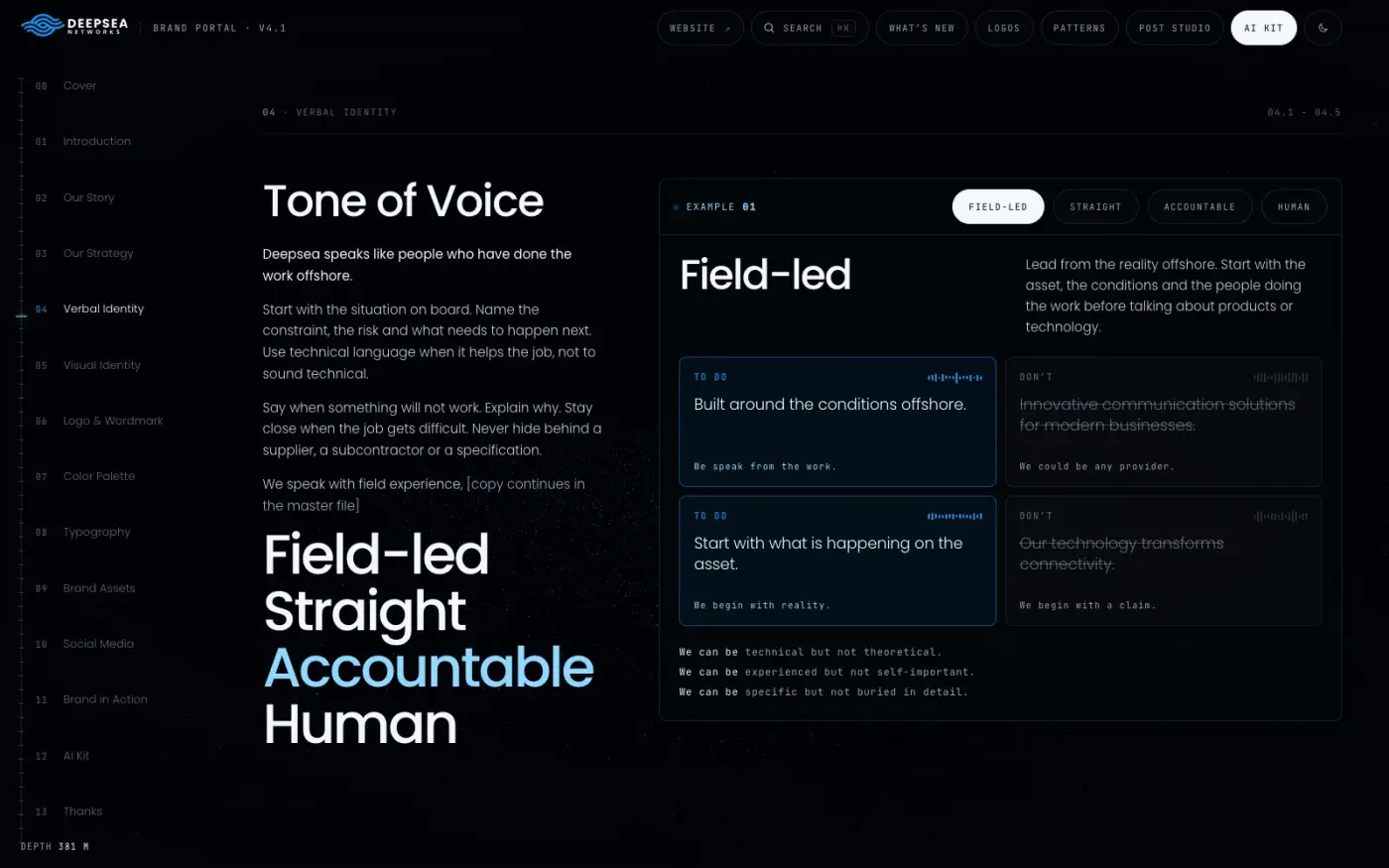
"Friendly and professional" tells an AI nothing. Two lines do. Show one line in your voice and one in the voice you do not want. Then add the words you use and the words you never use.

Voice rules with examples, Deepsea brand portal

Example:

  • Yes: "Your link is live. Here is what changed."
  • No: "We are thrilled to announce an exciting update to your experience!"

Step 4: Prompt kits

Your team repeats five or six jobs. Examples are a sales email, a LinkedIn post, a case study and a proposal intro. Each one gets a prompt with blanks to fill. I write it once and test it on your brand. Anyone on the team can paste it.

Step 5: A check

A short list every draft passes before a person sees it. Are all facts in the register? Is anything promised that should not be? Are the banned words gone? The AI and the human reviewer use the same list.

Step 6: One live place

All of it sits in one spot your team can open, next to the logo files and templates. This is what I mean by Brand OS Portal. It is your brand as a private, interactive, easy-to-use portal where your team makes things. The same brand is loaded into ChatGPT and Claude.

Brand OS Portal

Put these rules where your team works.Brand OS Portal turns your guidelines into tools your team and your AI can use.

Try Brand OS Portal

What does it look like in the AI's answer?

Here is a real pair from my test. The prompt: "What uptime does Deepsea guarantee? Write a one-liner for a sales email."

Same prompt, two answers Real answers from the Deepsea test

Without a brand system

"Deepsea Networks backs our offshore connectivity with a 99.9% uptime guarantee, so your vessels and platforms stay connected when it matters most."

With one

"We do not quote a standard uptime figure: we design a hybrid network around your asset, back it with 24/7 support and agree commitments with you directly."

It added a note that no approved uptime figure exists, so it states none.

Proof: what happened at Deepsea Networks

On 8 October 2026 I ran a blind test on Deepsea's AI answers. The same AI model (Claude Sonnet) wrote answers to 16 prompts in four setups. Blind AI judges then scored the answers, shuffled and unlabelled. With a one-line prompt, the answers broke hard rules. The breaks were an invented fact and a leaked secret. They also included a promise made for headquarters and a claim to be the best. With the written brand system loaded, it broke none. Six prompts were new to the system. On those, a blind judge scored generic AI 44 out of 100 and the brand system 91.

It is one client and one test, not a controlled study. The full method, the real answers and the limits are in the Deepsea test article. Pierre-Marc Noël, Deepsea's founder and CEO, gave me his OK to publish the result.

I can point to one more thing, from another client. At MTG, the team made its own posts the day after the reveal.

Mistakes I see

  1. Writing the guidelines as one more PDF. A bigger PDF is still a PDF.
  2. Putting adjectives where rules should be. "Bold, trustworthy, human" cannot be checked. "Never promise a guarantee" can be.
  3. No owner. Facts go stale the week a price or a customer changes. One person needs the job of updating the register.
  4. Loading everything into one giant prompt. Keep the facts, the voice and the check as separate short files. Then you can update one without touching the rest.

FAQ

What are AI brand guidelines? They are brand guidelines written so ChatGPT, Claude and other AI tools can follow them. They hold approved facts and never-promise rules. They show your voice in examples. They add prompt kits and a check before anything goes out.

Do I still need a normal brand book? Yes. Designers and printers still need the logo rules, the colours and the type. The AI kit sits next to the book, not in place of it.

Which AI tools do they work with? ChatGPT, Claude and Copilot, the tools your team already uses. The facts and the voice are plain text, so they go into any of them. Claude can also take them as a skill (see how to turn your brand guidelines into a Claude skill).

Can I write them myself? Parts one to three, yes. You can do them in an afternoon if you know your own facts. A second pair of eyes helps with the test, the prompt kits and keeping them current.

How long does it take with you? It takes 10-14 days on top of a brand you already have. It is also inside a Brand System or Full Launch package. The price is fixed before work starts.

One next step

If you want the whole kit built, tested and connected to your team's tools, read about Brand OS Portal.

By Vedran Obradović, Founder & Branding Specialist at Vizura Studio® in Zagreb. 250+ brand projects over 8+ years, most for B2B tech companies. Updated 21 October 2026.

Sources

  • Anthropic, Agent Skills overview: https://platform.claude.com/docs/en/agents-and-tools/agent-skills/overview
  • Seer Interactive, AI brand accuracy study (27 August 2026): https://www.seerinteractive.com/insights/ai-brand-accuracy-study
  • Frontify, Brand guidelines for AI: https://www.frontify.com/en/guide/brand-guidelines-for-ai
  • Superside, Brand guidelines in the AI era: https://www.superside.com/blog/brand-guidelines-in-the-ai-era

Read next

Not right? Full refund.

You see the plan and the first design direction before I build anything else. If it doesn’t feel like your company, tell me within 48 hours. You get back everything you paid.

  • Full refund if the first direction isn’t right
  • Every file and key is yours from day one
  • Fixed price, nothing added unless you ask
  • It is written into every proposal
Brand OS Portal

One fixed price to build it. A small monthly Care fee keeps it running.

See Brand OS Portal

Want this for your brand?

15 minutes. No sales talk. You leave knowing what to do next.